

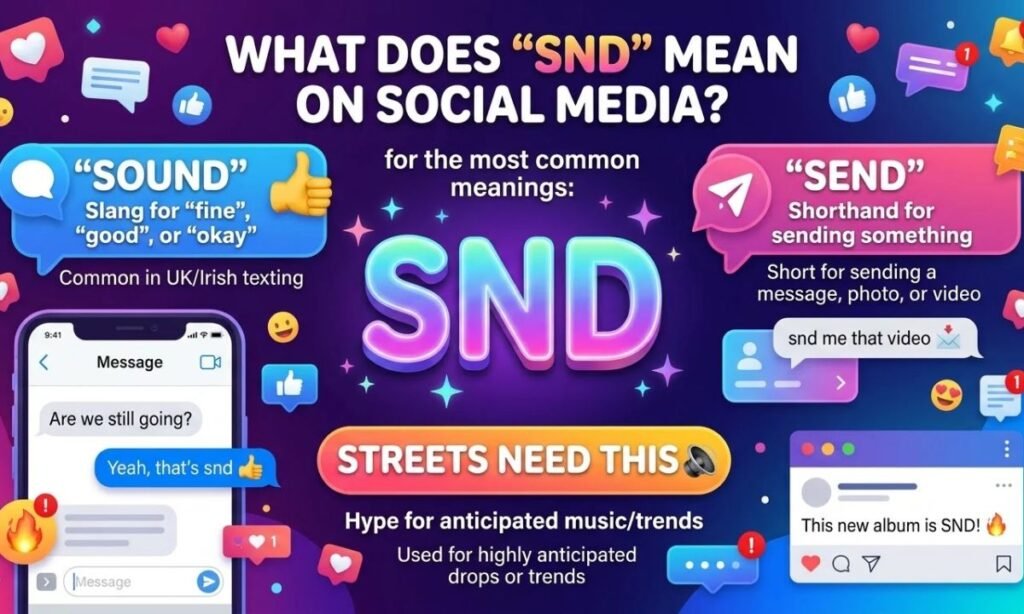
In a text or DM, SND most often means “sound,” a British slang word for “good,” “cool,” or “I’m in.” In some chats it is simply short for “send,” as in “snd me the link.” Context tells you which one the sender means.
If you saw it on Snapchat, TikTok, or Instagram, a reply like “SND” or “SND!” is usually a quick yes. It is a friendly, casual response to a plan or an idea.
Below, you’ll find each meaning, real examples, and simple replies. You’ll also see how SND differs in gaming, medicine, and other fields, so you can tell which meaning applies to your message.
What Does SND Mean in Text?

On Snapchat, SND usually stands for “sound,” British slang for something or someone likable or enjoyable, similar to “cool” or “awesome.” That is the most common meaning in casual chats.
SND can also be a lazy-typing shortcut for “send.” Here, someone is asking you to send a photo, file, address, or link, or telling you they are about to send one.
A quick way to tell them apart:
- “Sound” (approval): It answers a plan or idea. Example: “Wanna grab food at 7?” → “SND.”
- “Send” (action): It asks for or announces something being sent. Example: “snd me the notes.”
Background and Origin
The “sound” meaning comes from British slang, where “sound” has long meant reliable, decent, or good. Phrases like “that’s sound” or “he’s a sound lad” are common in the UK and Ireland. Social media then shortened the word to SND, because fast typing and character limits favor abbreviations.
The “send” meaning follows an older texting habit: dropping vowels. Words like “pls,” “msg,” and “txt” work the same way, and “snd” is the vowel-less version of “send.”
Because both uses developed informally, no single authority defines SND. Meaning comes from how people use it in context.
How SND Is Used in Different Contexts

Casual Use Between Friends
Among friends, SND is a quick, relaxed way to agree. It works as a reply to plans, jokes, photos, or stories. It can be a standalone message or attached to a longer one, like “That sounds fun, SND.”
Formal vs. Informal Use
SND belongs in informal chat only. In emails, school assignments, or work messages, write “sounds good” or “send” in full. An abbreviation that has two common meanings can easily confuse the reader.
SND Meaning on Social Media Platforms
SND Meaning on Snapchat
On Snapchat, SND usually means “sound” when someone replies to a snap, story, or plan. It signals approval and enthusiasm. If someone sends a snap asking if you want to hang out and you reply “SND,” you are saying it sounds good.
SND Meaning on TikTok and Instagram
In comments and DMs, SND works the same way: a short positive reaction. Commenters may drop it under a post to show they like the idea or plan. Check the surrounding conversation, because a comment asking for something may use “snd” to mean “send.”
SND Meaning From a Guy vs. a Girl

The meaning does not change by gender. The word is the same whether a guy or a girl types it, and the conversation around it is what counts.
- Reply to a plan or idea: almost always “sound,” meaning “sounds good.”
- A request with an item, such as “snd pic” or “snd location”: it means “send.”
If a message from someone you don’t know uses “snd” to ask for personal photos or private information, don’t send anything you’re uncomfortable with. You can ignore the message, block the account, or report it in the app.
Examples of SND in Text Messages

As “sound” (agreeing):
- “Pizza after practice?” → “SND”
- “We’re meeting at the park at 5.” → “SND, see you there!”
- “I booked tickets for Friday.” → “SND!! Can’t wait.”
As “send” (action):
- “snd me the address pls”
- “I’ll snd the photos tonight.”
- “Can you snd that link again?”
Other Meanings of SND in Different Fields

SND appears in many fields outside texting. Context makes the meaning clear, because the setting is very different.
SND Meaning in Gaming (Call of Duty and Others)
In shooter games like Call of Duty, SnD means Search and Destroy, a competitive mode in which one team plants a bomb and the other defends. It is often written “SnD.” Search and Destroy is a game mode found mainly in first-person shooters, and it is often written “SnD.”
SND Meaning in Medicine
In medical settings, SND can stand for sinus node dysfunction, a heart rhythm condition. Sinus node dysfunction is one of the listed meanings for SND. It is a clinical term and has nothing to do with slang. If you see it in a medical record, ask your doctor to explain it.
Other Uses
- Scottish National Dictionary: a reference work for Scots language.
- Slovak National Theatre (SND): the national theatre of Slovakia.
- .snd files: an audio file extension.
- Supply and demand: sometimes shortened to SND in trading and finance chat.
Common Misconceptions

- “SND always means something inappropriate.” That is not true. The most common usage is the friendly “sound” or the plain “send.”
- “SND is the same as SNF.” It is not. SNF usually means skilled nursing facility in healthcare, and Sunday Night Football in sports talk.
- “SND is only American slang.” The “sound” meaning comes from British English, so you may see it more often from UK users.
- “SND has one official definition.” It does not. It is informal slang, so meaning depends on context.
Similar Terms and Alternatives

If SND is not your style, try these:
- Sounds good or SG: a direct way to agree
- Bet: informal for “okay, sure”
- Down: “I’m down” means I’m in
- Sure or Ok: simple and universal
- Send (written out): when you mean the action
How to Respond When Someone Uses SND

Match your reply to the meaning:
If it means “sound” (they like the idea):
- “Great, see you then!”
- “Perfect, I’ll text you when I leave.”
If it means “send” (they want something):
- “Sure, sending it now.”
- “Which one do you want me to send?”
If you’re not sure: ask. “Do you mean sound or send?” is a quick, friendly question, and it avoids a mix-up.
SND vs. Similar Terms

- SND vs. SG: both can mean agreement. SND is slangier and tied to British “sound,” while SG is a plain shortcut for “sounds good.”
- SND vs. SNT: SNT is not a standard slang term, so you may be seeing a typo.
- SND vs. SND (gaming): gamers write SnD, usually with capital letters in the game’s own context.
- SND vs. SNF: unrelated. SNF refers to nursing facilities or football, not texting slang.
SND in Online Conversations and Dating Apps

On dating apps, SND usually follows the same rules: “sound” when it answers a suggestion, and “send” when it asks for something. Because “send” can lead to requests for photos, think before you reply, and trust your instincts.
It is fine to say no, ask the person to explain what they mean, or end the chat. Be especially careful with people you haven’t met, and never share private details or images you wouldn’t want shared widely.
Frequently Asked Questions
What does SND mean in a text message?
It most often means “sound,” slang for good or cool, as in “sounds good.” It can also be a shortened “send,” depending on the sentence.
What does SND mean on Snapchat?
On Snapchat it usually means “sound,” a casual approval or agreement. Replying “SND” to a plan or a story means you like it.
Is SND the same as “send”?
Sometimes. “Snd” can be a typing shortcut for “send,” such as “snd me the link.” The meaning depends on whether the message expresses agreement or asks for something.
What does SnD mean in Call of Duty?
SnD means Search and Destroy, a competitive game mode where one team plants a bomb and the other defends against it.
What does SND mean medically?
In medicine, SND can stand for sinus node dysfunction, a condition affecting the heart’s natural pacemaker. It is a clinical term and unrelated to texting.
How do I reply if someone texts SND?
If it means “sound,” reply with something like “Great, see you then!” If it means “send,” ask what they want and send only what you feel comfortable sharing. If you can’t tell, simply ask, “Do you mean sound or send?”
Is SND used by both guys and girls?
Yes. It has the same meanings no matter who types it. Look at the conversation rather than the sender’s gender.
Last Word
SND has more than one meaning, but in texting two cover almost every case: “sound,” meaning good or cool, and “send,” meaning to send something. A plan or idea before it points to “sound,” and a request for an item points to “send.”
Outside slang, SND can mean Search and Destroy in gaming or sinus node dysfunction in medicine. Reading the context is the surest way to know which one applies.
When you’re unsure, ask the sender what they mean. It takes seconds, and if the message asks for something private, you stay in control of what you share.